Essay · September 19, 2026
Table Partitioning in Relational Databases
How PostgreSQL partition pruning avoids scanning irrelevant data and changes a query's execution plan.
Table partitioning lets us break a large logical table into multiple, smaller physical pieces. Each partition’s heap and index files are stored separately on disk.
This can lead to faster query responses when most of the matching records live in a single partition. PostgreSQL uses the query’s WHERE clause to prune partitions it knows cannot contain relevant rows.
To see this in action, I created two simple tables: test2 and test3. Both use a custom enum type called status, whose possible values are status1, status2, status3, status4, and status5.
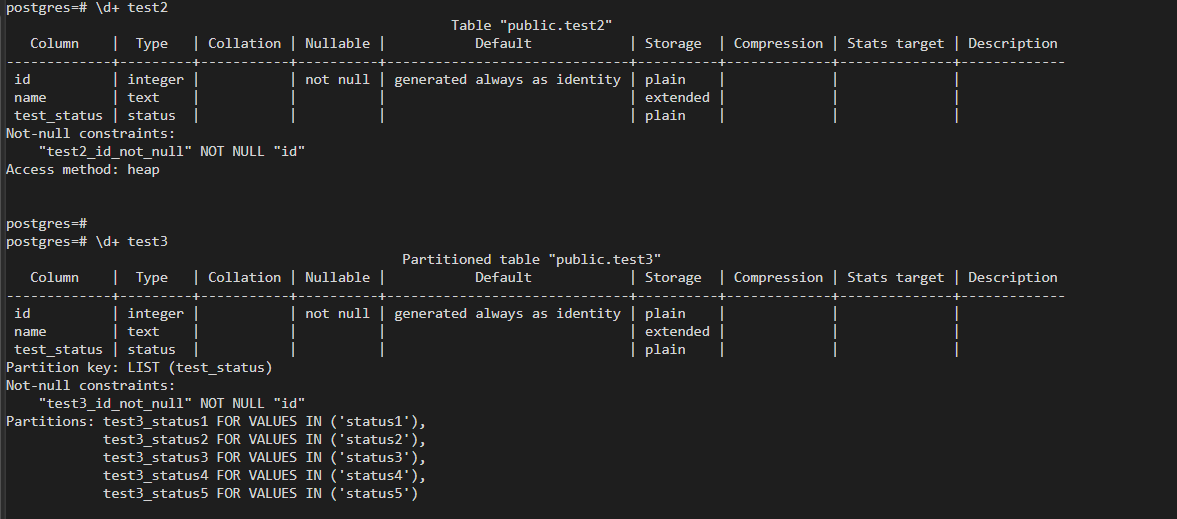
The tables share the same columns, but test3 is partitioned on test_status. It has one list partition for each possible status value.
Now let’s select every row whose test_status is status5 from both tables and compare the results with EXPLAIN ANALYZE:
EXPLAIN ANALYZE
SELECT * FROM test2 WHERE test_status = 'status5';

EXPLAIN ANALYZE
SELECT * FROM test3 WHERE test_status = 'status5';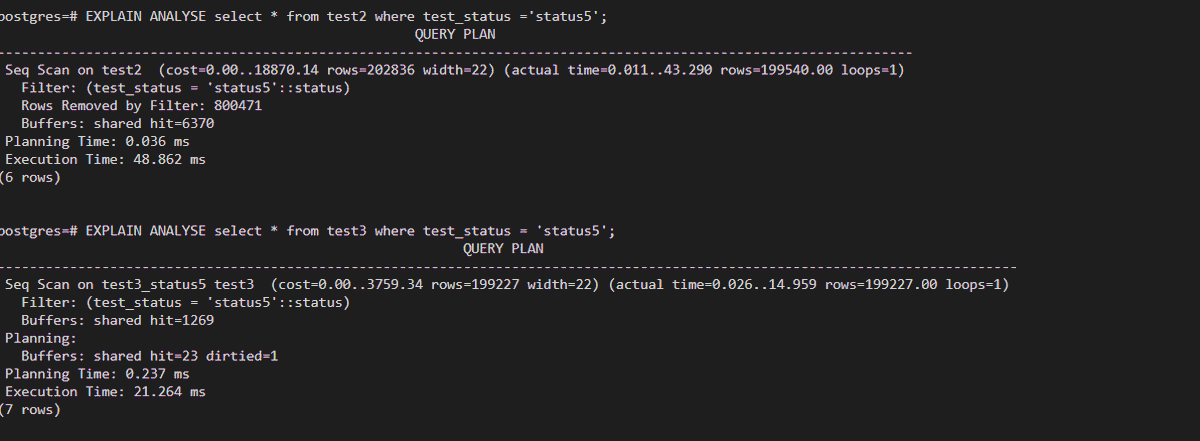
Both queries use a sequential scan. The important difference is where that scan happens.
For test2, PostgreSQL scans the entire table and filters out rows with other statuses. For the partitioned test3, it scans only test3_status5. PostgreSQL prunes the other four partitions because the WHERE clause makes it clear they cannot contain matching rows.
That is the practical benefit of partition pruning: even when the chosen access method is still a sequential scan, PostgreSQL can limit that scan to the relevant physical partition instead of reading the whole logical table.
Hope this helps!